
SpaceX Starlink- Launch Alert!
Update- SpaceX successfully launched and recovered the first stage of the Falcon 9 rocket. Yesterday’s recovery was the first time that SpaceX recovered a booster for the fifth time. This will help pave the way to continued reusability of the Falcon 9 rocket. The 60 Starlink satellites have also been deployed. Congratulations to SpaceX on another successful mission, which launched a day before the first launch of the Falcon 9 in history.
SpaceX will launch the latest batch of 60 Starlink satellites on a Falcon 9 rocket later tonight. Liftoff is scheduled for 9:25 p.m. EST from Space Launch Complex 40 at Cape Canaveral Air Force Station.
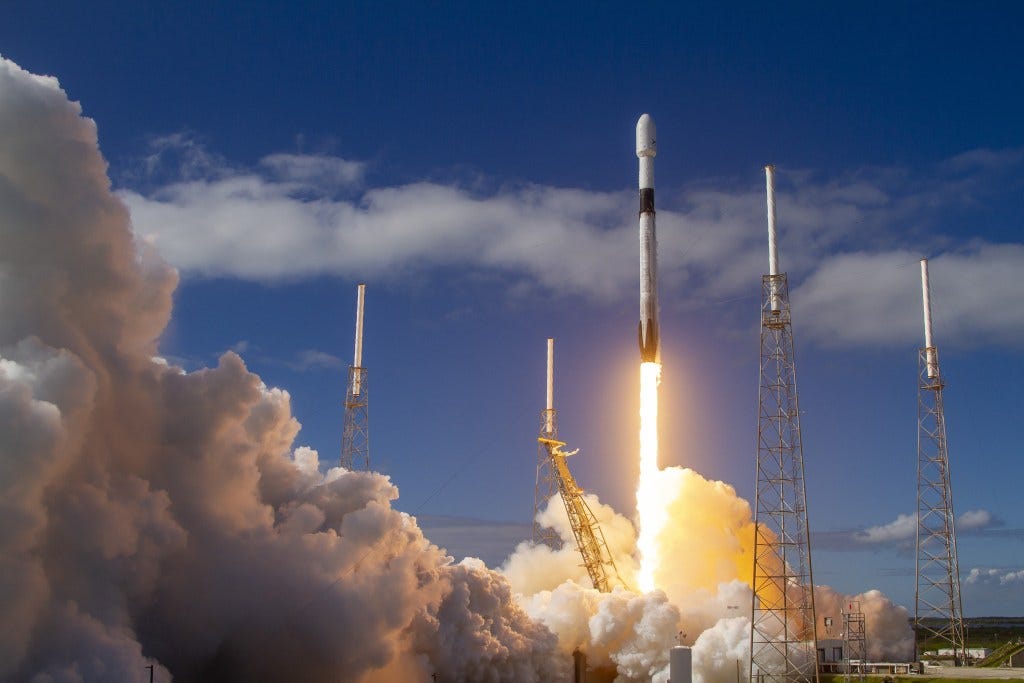
Once fully operational, the Starlink satellite constellation will provide low-cost, high-speed internet access on a global scale.
Today’s launch is the eighth Starlink mission overall, and the sixth of the year. The Falcon 9 first stage used in today’s launch will be launching for the fifth time; it previously supported Starlink, Iridium, and Telstar satellite launches.
Once completed, the Starlink constellation should consist of more than 12,000 satellites in Low Earth Orbit. Twelve thousand satellites is an unparalleled amount of spacecraft for a constellation, which poses a unique problem for orbital debris prevention. SpaceX notes that it designed Starlink satellites to deorbit with the onboard thruster at the end of their service life, to ensure defunct Starlink satellites don’t pose a threat to the space environment.
The Starlink constellation is not without controversy, as the satellites have already caused problems for amateur and professional astronomers. Harvard astronomer Jonathan McDowell notes in a whitepaper that in their present design, Starlink satellites will present astronomers with a night sky that has “tens of thousands of relatively large (few arcsecond angular size) satellites.”
SpaceX has shown that they are rapidly improving on the design of their Starlink satellites, making them less visible from the ground, once they are at their operational orbit. Most recently, SpaceX has noted that newer versions of the satellites will employ a visor setup that will “block sunlight from hitting the brightest parts of the spacecraft.” This upcoming launch includes a test of the visor, and all future satellites will incorporate this design improvement.
SpaceX’s record of improving existing designs has put the company in a unique position in the launch services market. The Block 5 Falcon 9 rocket is designed with reusability in mind. Instead of expending the first stage of the rocket, SpaceX can recover the booster, enabling the company to drive down launch costs in ways that its competitors are unable to match.
SpaceX’s prices are so competitive that they’ve caused Dmitry Rogozin, the head of Russia’s Space Agency, to claim that “Roscosmos will reduce the cost of launch services by more than 30% in order to increase its presence in international markets in response to dumping by American companies” to be more attractive for commercial launches.
Tonight’s launch comes days after SpaceX successfully launched NASA’s Demo-2 mission to the International Space Station (ISS). The Demo-2 mission is the first time that astronauts have flown on a commercial spacecraft to the ISS.
SpaceX performed the first commercial cargo resupply demonstration flight to the ISS with their first-generation Dragon spacecraft in 2012. It’s important to note that NASA’s Commercial Cargo and Crew programs have benefitted from bipartisan support since their inception in the Bush and Obama Administrations, respectively.
You can check out the launch Webcast on SpaceX’s website by checking out this link.